

 CN
CN
 EN
EN
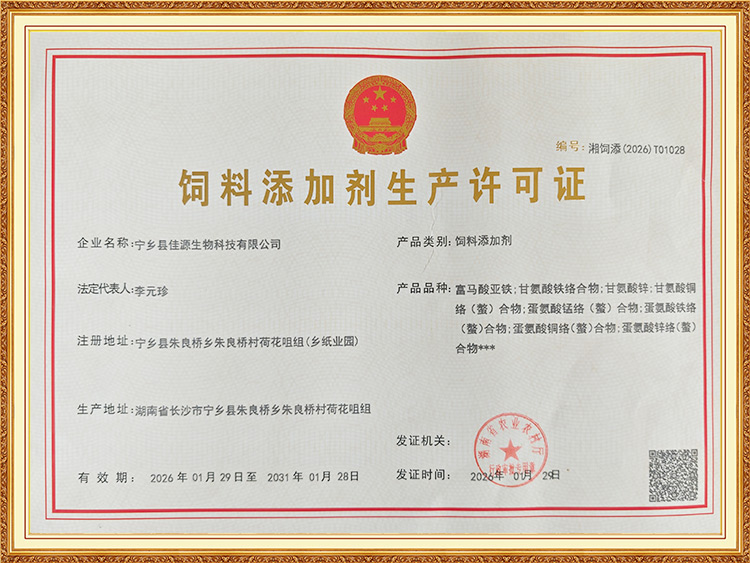
Production License for Feed Additives
Certification body: Hunan Provincial Department of Agriculture and Rural Affairs
Certificate Number: Xiangshi Tian (2026) T01028
Validity period: 2026-2031
FAQ
Our feed formula has always used inorganic trace elements such as ferrous sulfate, which are inexpensive. Why are more and more feed factories turning to organic trace elements now? What are its obvious advantages?
+ -Traditional ferrous sulfate is prone to moisture absorption and agglomeration in humid and hot environments, and may be oxidized to trivalent iron, which has a certain impact on the vitamin activity in feed. Its iron absorption rate is relatively low, and some nutrients are not fully absorbed and excreted from the body. Glycine iron complex and ferrous fumarate are organic iron sources with relatively stable chemical structures. According to customer feedback, the bioavailability of organic iron is usually significantly higher than that of inorganic iron. The use of such products can help improve animal growth performance and immunity, while reducing mineral element addition by about 30% and heavy metal emissions in feces by about 25%. It provides a feasible balance between cost reduction, efficiency improvement, and green environmental protection.
How effective is your ferrous fumarate and glycine iron complex in iron supplementation and anti anemia for sows and piglets compared to iron injection? Is it troublesome to use?
+ -It is not complicated to operate and can achieve iron supplementation effects similar to intramuscular injection through maternal addition. Adding ferrous fumarate to the diet of sows 2 weeks before and 3 weeks after delivery can provide iron sources for piglets through breast milk, and its weight gain and iron supplementation effects are similar to those of intramuscular injection for piglets after birth. Meanwhile, the glycine ligand in the glycine complex plays a role in heme synthesis, helping to effectively transport iron to target cells with high absorption efficiency. This method can effectively save labor costs for manual injection, and the pure feed addition method is more suitable for standardized feeding management in modern aquaculture.
Feed safety is related to the operation of the entire farm. How do you ensure the screening of raw materials and control of heavy metals in the breeding process?
+ -Food safety begins with feed safety, and raw material traceability is an important link in quality control. The company adopts a strict strategic supplier system and conducts comprehensive testing on every batch of incoming raw materials to effectively prevent inferior materials from entering the production process. The production end is equipped with detection equipment such as atomic absorption spectrophotometer, high-performance liquid chromatography, gas chromatography, as well as advanced instruments such as atomic fluorescence spectrophotometer (AFS). The testing content not only includes the content of active ingredients, but also strictly follows the national feed hygiene standards (GB 13078-2017) and the standards of the exporting country to test the harmful indicators such as arsenic, lead, mercury, cadmium and aflatoxin in the feed, ensuring that each batch of factory products meets relevant regulatory requirements.